


 Online Course
  Student
  CE
CE Description
The ALS: Respiratory Emergencies Module covers several of the most common respiratory emergencies including severe asthma, cardiogenic pulmonary edema, anaphylaxis, peri-intubation arrest, pulmonary embolism, and noncardiogenic pulmonary edema. It educates students on the identification of signs and symptoms, descriptions of treatments, potential complications, and considerations. The goal of this module is how to treat these respiratory emergencies before they lead to cardiac arrest.
This eLearning course features True Adaptive™ learning, where students follow a learning path personalized by their own inputs and self-reported confidence level.
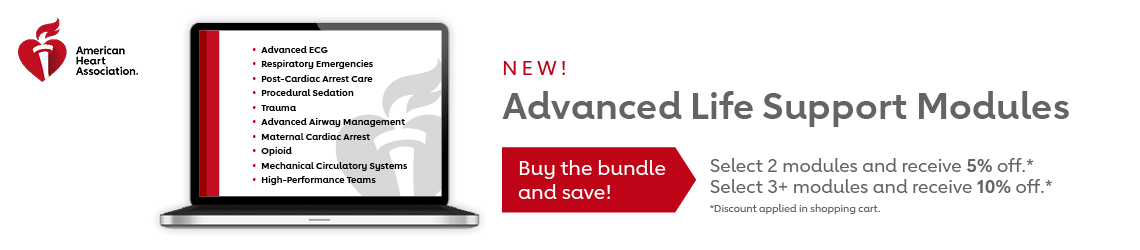
Bundle & Save! Save up to 10% when you purchase ALS modules as a bundle.
Learn More >
Technical Requirements
Please refer to elearning.heart.org for specific course technical requirements.
Product Specifications
- Associated Course : ALS
- Format : Online Course
Continuing Education Information
Advanced Life Support: Respiratory Emergencies; Enduring Web Course
Original Release Date: 12/12/2022
Last Review Date: September 2025
Termination Date: 12/11/2028
Description
This module will cover several of the most common respiratory emergencies, including severe asthma, cardiogenic pulmonary edema, anaphylaxis, peri-intubation arrest, pulmonary embolism, and noncardiogenic pulmonary edema. Identification of signs and symptoms, descriptions of treatments, potential complications, and considerations will be presented. The goal of this module is to treat these respiratory emergencies before they lead to cardiac arrest.
Learning Objectives
At the conclusion, participants should be able to:
1. Recognize and explain treatment for severe asthma
2. Recognize and explain treatment for cardiogenic pulmonary edema
3. Recognize and explain treatment for anaphylaxis
4. Recognize and explain treatment for peri-intubation arrest
5. Recognize and explain treatment for pulmonary hypertension due to pulmonary embolism
6. Recognize and explain treatment for noncardiogenic pulmonary edema due to narcotics overdose
Accreditation Terms
Joint Accreditation: 12/12/2025 – 12/11/2028
CAPCE: 12/12/2025 – 12/11/2028
AARC: N/A
Accreditation Statements
Joint Accreditation Statements
In support of improving patient care, this activity has been planned and implemented by The American Heart Association. The American Heart Association is jointly accredited by the Accreditation Council for Continuing Medical Education (ACCME), the Accreditation Council for Pharmacy Education (ACPE), and the American Nurses Credentialing Center (ANCC), to provide continuing education for the healthcare team.
AMA Credit Designation Statement - Physicians
The American Heart Association designates this activity for a maximum of 0.75 AMA PRA Category 1 Credits™. Physicians should claim only the credit commensurate with the extent of their participation in the activity.
AAPA Credit Acceptance Statement – Physician Associates
AAPA accepts certificates of participation for educational activities certified for AMA PRA Category 1 Credit™ from organizations accredited by ACCME or a recognized state medical society. Physician associates may receive a maximum of 0.75 hours of Category I credit for completing this program.
AANP Credit Acceptance Statement – Nurse Practitioners
American Academy of Nurse Practitioners (AANP) accepts AMA PRA Category 1 Credit™ from organizations accredited by the ACCME.
ANCC Credit Designation Statement - Nurses
The maximum number of hours awarded for this CE activity is 0.75 contact hours.
Continuing Education Accreditation – Emergency Medical Services
This continuing education activity is approved by the American Heart Association, an organization accredited by the Commission on Accreditation of Pre-Hospital Continuing Education (CAPCE), for 0.75 Advanced CEHs, activity number 25-AMHA-F3-0064.
By claiming CAPCE credit, the claimant acknowledges the following: I understand that the American Heart Association as a requirement of CAPCE accreditation will submit a record of my course completions to the CAPCE AMS. I further understand that my course completion records may be accessed by or shared with such regulators as state EMS offices, training officers, and NREMT on a password-protected, need-to-know basis. In addition, I understand that I may review my record of CAPCE-accredited course completions by contacting CAPCE.
Participation and Successful Completion
Successful completion of this CE activity includes the following:
1. Complete all portions of the online course
2. Complete the course evaluation
3. Print the Certificate/Statement of Credit
Disclosure Statement
All persons in a position to control educational content of a CE activity provided by the American Heart Association must disclose to the audience all financial relationships with ineligible companies whose primary business is producing, marketing, selling, re-selling, or distributing healthcare products used by or on patients. The presence or absence of all financial relationships will be disclosed to the audience in activity materials. All unlabeled/unapproved uses of drugs or devices discussed will also be disclosed to the audience. All relevant financial relationships have been mitigated prior to the commencement of the activity.
The following authors/faculty have declared NO financial interest(s) and/or affiliations:
Gustavo E. Flores, MD, NRP, FP-C
Sallie Johnson, PharmD, BCPS
Kenneth Navarro, MEd, LP
Comilla Sasson, MD
Elizabeth Sinz, MD, MEd
Erik Soderberg, MS
Amber Hoover, RN, MSN
This list represents the relationships that may be perceived as actual or reasonable conflicts of interest as reported on the Disclosure Questionnaire, which all AHA volunteers are required to complete and submit. The focus is on relevant financial relationships with commercial interests in the 24-month period preceding the time that the individual is being asked to assume a role controlling content:
Brian K. Walsh, PhD, RRT - Vapotherm - Researcher, Elsevier - Book Royalties, VERO Biotech - Advisor, FluidIQ - Employee and ownership interest
Target Audiences
1. Physicians
2. Physician Associates
3. Nurse Practitioners
4. Nurses
5. EMS: Paramedics
Accessibility Statement
The American Heart Association and American Stroke Association strive to make our websites accessible. The American Heart Association and American Stroke Association are committed to diversity, inclusion, and meeting the needs of all our constituents, including those with disabilities. We are continually improving our digital assets to comply with the accessibility guidelines for levels A and AA in accordance with WCAG 2.1.
If the format of any material on our web pages interferes with your ability to access the information, please contact us to request assistance, or if you have questions or comments about our web sites’ accessibility.


